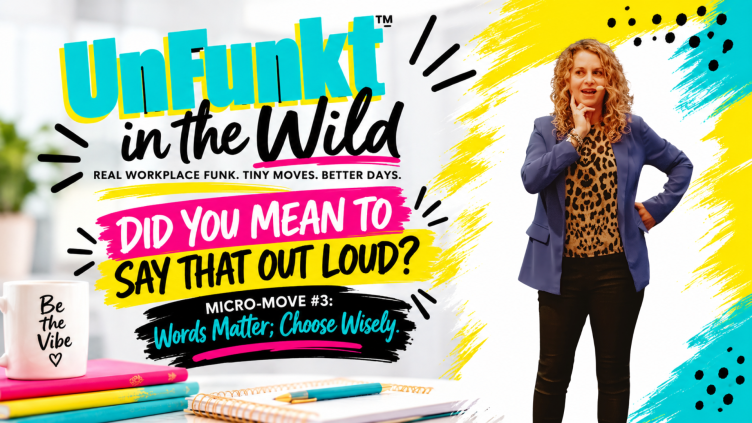
Micro-Move #3: Words Matter. Choose Wisely.
Can we talk about some of the things people say? Because sometimes I hear something and think, “Did you actually mean to say that out loud?”
Take “Per my last email.” Really? Was that necessary? We all know what you’re saying. And chances are, the person reading it does too. Or my personal favorite, “Calm down.” Has that EVER worked? In the history of telling someone to calm down, has anyone actually responded, “You know what? You’re right. I feel so much better now. Thank you!” Probably not.
We’ve all said things we wish we could take back. Sometimes we’re frustrated. Sometimes we’re distracted. Sometimes our mouths just get ahead of our brains. I’ve certainly been guilty of it. But here’s something I’ve learned after years of working with leaders, teams, and organizations: It’s not always WHAT you’re saying that’s creating the problem. Sometimes it’s HOW you’re saying it.
And sometimes, it’s what you’re communicating without even realizing it.
WHAT’S BEEN THE BEST PART OF YOUR DAY?
If you’ve heard my TEDx talk or been in one of my sessions, you probably know I’m not a big fan of asking, “How are you?” Not because I don’t care. Quite the opposite. It’s because most of the time, we ask it without really expecting an answer. And most people respond with the standard “Fine, thanks. How are you?”
So years ago, I started asking a different question. “What’s been the best part of your day?”
I ask it everywhere. At the Starbucks drive-thru, checking out at Publix, at the doctor’s office. Pretty much anywhere I have an opportunity to connect with another human being. And let me tell you, the answers are always interesting.
Sometimes people light up. They’ll tell me about something wonderful that happened, a person they met, or something they’re looking forward to. But you know what answer I hear more often than you might think?
“When I get off work.” or “When my shift is over.” or “When I get to go home.” And I always find that fascinating.
Now, don’t get me wrong. I love going home too! But think about how that answer lands. If I’m at Publix, what does that tell me about how you feel being there? And if I’m sitting in a doctor’s office, maybe feeling nervous about an appointment, and the nurse or doctor tells me the best part of their day will be when they get to leave? Well, that’s comforting.
I know they probably don’t mean anything by it. They’re just answering my question. And maybe they’re having a really tough day. But here’s what I want us to consider. Just because something is true doesn’t mean we always need to say it out loud.
I’m all about authenticity. I’m not suggesting we pretend everything is wonderful when it’s not. And I’m certainly not asking anyone to fake happiness. But I do think we need to recognize that our words have an impact beyond what we intend.
That team member might simply be excited to get home to their family. But what I hear is that being at work is the worst part of their day.
That nurse might be exhausted after a long shift. Completely understandable. But what I hear as a patient might be that they can’t wait to get away from this place, and perhaps from me.
Intention and impact are not always the same thing. And that’s something worth paying attention to.
IT’S NOT JUST WHAT YOU SAY. IT’S WHAT YOU CHOOSE TO CALL IT.
Here’s something else you may not know about me. I am VERY intentional about certain words I use. And have been for years.
For example, I don’t use the word “employee.” I say team member. Why? Because an employee sounds like someone who works FOR you. A team member sounds like someone who works WITH you. Someone who belongs. Someone who contributes. Someone who matters. And yes, I know they’re technically employees. But that’s not the point.
I also don’t like the word “contract.” I prefer agreement, or even better, relationship agreement. Because when I work with a client, I’m not just signing a piece of paper and checking a box. We’re entering into a relationship. We both have expectations, responsibilities, and a shared goal.
And while we’re at it, I don’t just see them as clients. I see them as partners. (Unless they don’t pay their invoice. Then we might have to revisit the relationship. HA!) The language to reflect the relationship we’re building, not just the transaction we’re completing.
And this goes WAY back. When I was selling real estate, I never sold a “house.” I sold a home. And we didn’t sell “lots.” We sold homesites. Now, you might be thinking, “Jaime, isn’t that just semantics?” YES! That’s exactly what it is. And semantics matter!
A house is a structure. A home is where your life happens. A lot is a piece of dirt. A homesite is where you picture your kids playing in the backyard, hosting friends, or sitting on the patio with your morning coffee. See the difference?
One describes what something IS. The other helps people connect to what it MEANS. And the same goes for the people we lead, the clients we serve, and the relationships we build.
I’m not suggesting we all need to start carrying around a thesaurus or overanalyzing every word that comes out of our mouths. But I am suggesting that we pay attention to the language we use so often that we don’t even think about it anymore. Because words create pictures. Words shape expectations. Words influence how people see themselves, their work, and the people around them. And sometimes, changing one word changes the entire feeling of the conversation.
So here’s a question worth asking: Are the words you’re using reinforcing the culture and relationships you WANT to create, or are they simply the words you’ve always used?
JAIME’S MICRO-RANT: CAN WE RETIRE A FEW PHRASES?
While we’re talking about words, can we discuss a few workplace favorites?
“We’ve always done it this way.” Okay. And? Is that supposed to be the end of the conversation? Because I’m pretty sure we used to do a lot of things differently, and thank goodness we evolved.
“No offense, but…” Well, now I’m definitely preparing to be offended.
“You should have known that.” Should they? Did we actually communicate? Or did we just assume they could read our minds?
And let’s not forget the classic: “That’s not my job.” Maybe it isn’t. But there’s a big difference between saying that and saying, “I’m not the right person for that, but let me help you figure out who is.”
Same boundary. A very different experience. The point isn’t that we need to eliminate every imperfect phrase from our vocabulary. It’s that the words we choose can either open a conversation or shut it down. And if we’re not paying attention, we may be shutting down more than we realize.
THE LEADERSHIP CONNECTION: YOUR WORDS SET THE TONE
Here’s where this becomes especially important for leaders. Teams are listening. Not just to your instructions or your big speeches about culture and teamwork. They’re listening to how you respond when something goes wrong. How you talk about customers. How you speak about other departments. How you answer a simple question when you’re having a rough day.
Think about a leader who constantly says, “I’m drowning,” “This place is a disaster,” or “I can’t wait for Friday.” Now imagine that same leader wondering why their team seems disengaged.
I’m not saying leaders need to pretend everything is perfect. Far from it. Teams need honesty, transparency, and the freedom to acknowledge challenges. But there’s a difference between acknowledging a difficult situation and making negativity the soundtrack of your workplace.
Your words help shape what people believe is normal, acceptable, and possible.
When someone brings you a new idea, does your response encourage them to keep thinking or make them wish they’d stayed quiet?
When someone makes a mistake, do your words help them learn or make them afraid to try again?
And when you talk about your work, your customers, or your team, what message are you sending about how much they matter?
Sometimes the smallest comments have the biggest impact.
YOUR MICRO-MOVE: CHECK. CHOOSE. CONSIDER.
You don’t need to memorize a communication formula or spend 20 minutes crafting every sentence. But you can take a moment before you speak, respond, or hit SEND.
Here are three questions to help.
1. CHECK YOUR INTENTION: Am I making a point or making progress?
What am I actually trying to accomplish? Am I trying to solve a problem, understand someone, set a boundary, or just let my frustration out? There’s a time and place to vent. But the person standing in front of you may not be the right audience.
2. CHOOSE YOUR WORDS: Will this open the conversation or shut it down?
A few small changes can make a big difference.
- Instead of “Why didn’t you finish this?” try “What got in the way?”
- Instead of “That won’t work,” try “What would we need to change to make that possible?”
- Instead of “You should have known,” try “Let’s make sure we’re on the same page.”
And instead of “I can’t wait to get out of here,” maybe share something you’re looking forward to without making the person you’re serving feel like they’re part of the problem. It’s not about finding the perfect words. It’s about choosing words that help you get the outcome you’re hoping for.
3. CONSIDER YOUR IMPACT: How might this land on the other person?
This is the one I really want you to think about. Because we spend a lot of time defending what we meant.
“That’s not what I meant!” “I was just joking!” “You’re taking it the wrong way!”
But the person receiving your message doesn’t have access to the conversation happening inside your head. They only have the words you chose, your tone, and the experience you created.
You don’t get to decide how your words land. You only get to decide how intentionally you choose them.
Check. Choose. Consider. Three micro-moves steps. One powerful impact.
YOUR MOVE: ONE CONVERSATION. ONE SMALL SHIFT.
Here’s your challenge for the week. Choose ONE conversation each day where you pay a little more attention to your words.
- Maybe it’s an email you’re about to send when you’re frustrated.
- Maybe it’s a conversation with a coworker who’s missed a deadline.
- Maybe it’s the way you answer someone who asks how your day is going.
- Or maybe it’s the way you speak about yourself.
Before you respond, ask:
- What am I really trying to communicate?
- Could my words create defensiveness or distance?
- What’s one thing I could say differently to create a better outcome?
Then try it.
And pay attention to what happens. Did the conversation go differently? Did someone open up? Did you get a better response? You might be surprised what changes when you change just a few words.
ONE QUESTION BEFORE YOU GO
What’s one phrase people say at work that makes you cringe? You know the one. The phrase that makes you want to look around the room and ask, “Did everyone else just hear that?” I’d love to hear yours in the comments.
And while you’re thinking about everyone else’s questionable word choices, maybe consider whether you’ve got a phrase or two of your own that could use a little retirement party. Because here’s the thing. You can be authentic AND intentional. You can be honest AND thoughtful. You can have a hard day without making it someone else’s hard day.
Words matter. Choose wisely. And remember, little moves really do create big impact.
Until next time, keep shedding the funk!
Jaime

THE MICRO-MOVE DOESN’T END HERE.
What would happen if everyone on your team started paying a little more attention to the words they chose? Think about the impact on communication, trust, customer experience, and the overall energy of your workplace. That’s what UnFunkt™ is all about. Taking small, intentional actions that change how we lead, connect, and show up for others.
Want to bring that experience to your next conference or team event?
I bring UnFunkt™ to life through interactive opening and closing keynotes, workshops, and leadership experiences that get people thinking, talking, laughing, and most importantly, doing something differently.
Let’s Talk: Schedule 15 Minutes with Jaime
KEEP THE UNFUNKT™ GOING
READ IT. LISTEN TO IT. LIVE IT.
UnFunkt™: Quiet the Noise. Ignite the Light. is your choose-your-own-adventure guide to making small shifts that create big impact. Available in paperback, eBook, and audiobook.
Want complimentary access to the audiobook? Send me a message!
GOOD STORIES. REAL PEOPLE. FRESH PERSPECTIVES.
Join my dad, Stan, and me on What’s Your Story? as we explore the experiences, challenges, and moments that shape who we become.